Gurei Turns Boss Order Into a Weapon, Then Dares You to Use It
Our Gurei review digs into the boss-rush, the route-planning that reshapes every fight, the powers you steal, and the crashes still tripping it up.
Aymen Sakouhi·Writer · Games Hobbyist//5 min read
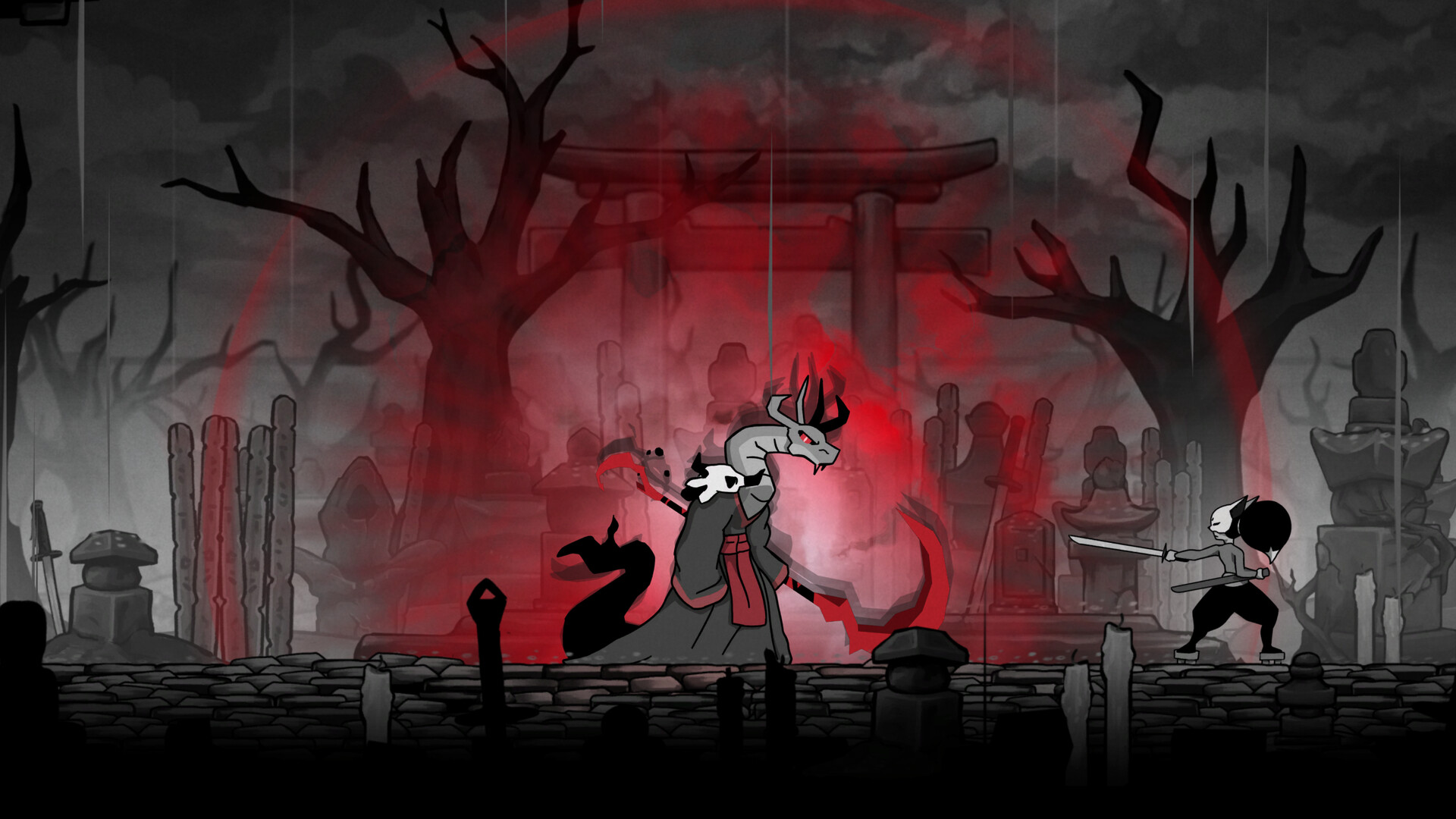
© Astrolabe Games. Official media via Steam.
The pitch
OverviewMost boss-rush games hand you a menu of fights and let you clear them in whatever order you like, and the order rarely matters. Gurei takes that same premise and makes the sequence the whole game. Lobo Sagaz studio, published by Astrolabe Games, builds its entire loop around a single question that other games treat as a formality: which monster do you kill first, and what does the rest of the run look like once you have.
You play Rei, a sword-wielding human spirit who wakes in a ruined castle with ten paths branching off it. Each path ends at a Kami, a possessed entity pulled from Japanese mythology, and each Kami has its own move set, its own mechanic, and its own way of dying. The catch is that every boss you leave standing grows more dangerous while you are busy elsewhere, so the fight you skip in hour one is not the fight you come back to in hour three. Deciding what to face while it is still manageable, and what to gamble on later, is the actual puzzle.
It launched on Steam on July 22, 2026 at a low premium price of just over fourteen dollars, and also arrived on PlayStation and Nintendo Switch the following day. That pricing matters: this is a compact, single-player action game that knows exactly what it is, sold at a fraction of a full release, and it wears its influences openly. Critics have reached for late-90s Mega Man, for Hollow Knight, for Nine Sols, and all three comparisons land in different ways.
Early reception has been warm but qualified. The aggregate critic verdict sits in the high 70s, with a majority of reviewers recommending it, and the small Steam player sample skews positive. The praise is almost unanimous about the design; the reservations are almost unanimous about who it is actually for, and about a launch that shipped rougher than it should have.
How it plays
PlayThe core loop is stripped to its bones on purpose. There is no sprawling map to explore, no trash mobs to grind, no inventory to babysit. You leave the castle hub, you walk a short path, you fight a Kami, and if you win you take one of that Kami's powers back with you. Everything you carry into the next fight is something you earned in a previous one, so a run is really a chain of decisions about which tools you want in your hands when the hard fights arrive.
What elevates this above a simple gauntlet is how the bosses change based on when you meet them. Every Kami you leave alive scales up, gaining new moves and new phases as its neighbors fall, which means the same encounter can be a gentle warm-up or a brutal wall depending purely on where you slotted it into your run. The developers claim the branching produces millions of possible route permutations, and while that figure is the kind of number studios love to print, the underlying idea holds: you are constantly weighing a familiar, predictable fight now against an unpredictable, escalated version of it later.
Combat itself is tight and readable rather than flashy. Rei has a sword, a dodge, and the borrowed powers, and the moment-to-moment rhythm is about pattern recognition and precise spacing more than combo memorization. Each Kami is a lock, and the powers you have banked are the keys, so a boss that feels impossible on one run can crumble on the next once you bring the right stolen ability to bear. That interplay between build and sequence is where the game is at its best, and it rewards experimentation in a way a fixed difficulty curve never could.
Permadeath sets the stakes. Losing a run sends you back, and because the whole structure is built around planning, a death is not just lost time but a referendum on your route. The autosave is generous enough that you rarely lose real progress to a technical fault, but the design wants you to feel the weight of each committed choice, and it mostly succeeds. Runs are short by genre standards, which cuts both ways: the tight length keeps the planning loop from getting bloated, but it also means the content pool empties faster than some players will want.
The friction is real and worth naming. The difficulty curve is steep with very little onboarding, so players who do not already speak the language of precise, punishing action games can bounce off hard. There is a fair amount of backtracking through the hub between fights, and it starts to feel like padding on later runs. Accessibility options are present, including camera comfort settings, custom volume controls, and a keyboard-only mode, which is more consideration than many indies of this size offer, but none of that softens the fundamental fact that this is a demanding game that expects you to fail your way to competence.
Art & atmosphere
CraftVisually, Gurei commits to a stark, deliberately retro silhouette-forward look that owes an obvious debt to the action platformers of the late 1990s. The Kami are the showpieces, each designed to read instantly at a glance so you can parse a new move set in the split second before it kills you, and the mythological framing gives the roster a cohesion that a lot of boss-rush games lack. Readability is doing heavy lifting here, and the art direction understands that in a game this punishing, clarity is not a compromise but a mechanic.
The ruined-castle hub and the ten paths radiating from it lend the whole thing a quiet, melancholy frame between the noise of the fights. There is a sense of a dead place slowly being unmade as you strip its guardians of their powers, and that mood does more narrative work than any cutscene. Sound design leans functional, with audio cues that telegraph attacks cleanly, which again serves the combat first.
Where the presentation stumbles is stability rather than style. At launch, multiple reviewers reported frequent crashes, with the Switch version in particular kicking players back to the home menu on run after run. Autosave means those crashes cost time and momentum rather than real progress, but a game whose entire appeal is committed, high-stakes runs is badly served by a technical fault that keeps interrupting them. This is a fixable problem, not a design one, and it is the single biggest thing standing between the game and a stronger verdict.
A genuinely clever twist on the boss-rush formula, held back from a higher mark by a narrow audience and a crash-prone launch.
Pros & cons
The ledgerIn its favour
- Route planning turns boss order into a genuine strategic layer, not a formality
- Bosses that scale as their neighbors fall keep every run feeling different
- Tight, readable combat built on spacing and pattern reading rather than rote combos
- Stolen-power system rewards experimentation and makes tough fights solvable
- Compact price and honest scope for a focused single-player experience
- Thoughtful accessibility touches including camera comfort and a keyboard-only mode
Against it
- Frequent crashes at launch, especially on Switch, repeatedly break the run flow
- Steep difficulty with minimal onboarding will lose less-hardened players
- Hub backtracking between fights starts to feel like padding on later runs
- Short overall runtime empties the content pool quickly
- Demands genre fluency and offers little help to those who lack it
Screens
Official media© Astrolabe Games. Official media via Steam.
The player verdict
Real reviews · Steam- Recommended
“(Ignore the playtime, I was one of the playtesters and have a few hundred hours in total) It's always refreshing to see unique spins on well-established genres. The premise of the game is very straightforward: You enter each boss arena,…”
33 found helpfulvia Steam - Recommended
“It’s incredibly fun and easily has S-tier art and visuals. The combat variety is great, keeping things fresh, and the story is genuinely intriguing.My only minor gripes are the i-frames, they can feel a bit weird/inconsistent at times.…”
10 found helpfulvia Steam - Recommended
“TLDR: Fantastic game that puts a refreshing twist on the boss rush genre. If you are new to the genre you should beware that these are difficult games. What is this game? -There are 10 (or more?) bosses. I have not beat the game yet. It…”
8 found helpfulvia Steam - Recommended
“Yooo! Quick Review to give the game some motion. Gameplay: Its a boss rush game. Its like mega man without the annoying levels. Right to the hands within a few min of starting. You choose who you want to fight and the game gets…”
6 found helpfulvia Steam
Verdict
The callGurei is the rare boss-rush that has an actual idea, and it follows that idea all the way down. By making the order of your fights the central decision and letting every boss mutate around your choices, it manufactures replayability out of structure rather than padding, and the borrowed-power loop gives each run a satisfying sense of build and consequence. When it clicks, it is one of the smartest small action games of the year, and its low price makes the bet easy to justify.
The reservations are just as clear. This is a hard game that does little to bring you along, so if you do not already enjoy failing repeatedly at precise action combat, the door is not being held open for you. The short runtime and the hub backtracking chip at the experience the longer you play, and the launch crashes, most acute on Switch, undercut exactly the committed-run fantasy the design is chasing.
For players who came up on Mega Man, Hollow Knight, and Nine Sols and want something lean, deliberate, and genuinely fresh in how it is structured, Gurei is an easy recommendation, ideally after a patch or two settles the stability. For everyone else, admire the idea from a distance and wait to see whether the studio smooths the rough edges.
Sources
Original review by Aymen Sakouhi from the licensed facts above. Score: 7.5/10.