Forensics: Crime Scene Detective Wants Your Patience Before It Earns Your Trust
Our Forensics: Crime Scene Detective review examines the realistic lab work, the deliberate pace, and the tutorials and bugs holding a good idea back.
Aymen Sakouhi·Writer · Games Hobbyist//5 min read
© Aerosoft GmbH. Official media via Steam.
The pitch
OverviewMost crime games are power fantasies dressed as detective work: you follow a glowing trail, you accuse the obvious suspect, you get a cutscene. Forensics: Crime Scene Detective is not interested in that. Developed by Binary Impact and Alchemical Works and published by Aerosoft, it is a deliberate, procedure-first simulator that cares less about the drama of catching a killer than about the unglamorous discipline of documenting a scene correctly and running the evidence through a lab.
The framing is authenticity. The studios lean on input from real criminal-investigation experts, and it shows in the structure: you photograph and collect microscopic evidence at a scene, then move to the lab to process DNA, ballistics, and digital traces before you build toward identifying a perpetrator. Scenes range from cramped apartments to public spaces like bars, and the appeal is the methodical rhythm of doing forensic work properly rather than the thrill of a chase.
It launched on July 13, 2026 on PC, PlayStation 5, and Xbox Series X and S at twenty dollars, positioning itself as a mid-priced niche sim rather than a blockbuster. That pricing is honest about what it is. The trouble is that the launch build is honest about that too, in ways the developers probably did not intend.
Early reception tells a consistent story. Steam players have settled into a Mixed rating, with a slim majority recommending it, and the split is easy to read: the people who wanted exactly this kind of slow, authentic lab sim mostly got it, while a large minority ran headfirst into friction, confusion, and bugs that a few more months in development would have caught. This is less a bad game than a promising one that clocked out before quality control finished its shift.
How it plays
PlayThe core loop splits neatly into two halves: the scene and the lab. At a crime scene you survey the space, photograph what matters, and collect physical evidence, and the game asks you to be thorough and careful rather than fast. Back in the lab, that evidence becomes work: DNA analysis, ballistic comparison, digital forensics, each presented as a process to follow rather than a button to press. When it flows, there is a real satisfaction in watching a case assemble out of small, patiently gathered pieces, and that texture is unlike almost anything else in the crime genre on the storefront.
The deliberate pacing is the whole point, and it is also the first thing that will filter players. This is a slow game by design, and it does not apologize for the time it takes to do things properly. If you find quiet, careful procedure absorbing, the tempo is a feature. If you came expecting momentum, it will feel like wading. The game is clearly built for the former audience, and it makes little effort to convert the latter.
Where the design actively works against itself is friction that is not deliberate, just unfinished. The most cited example is a one-item carry limit at crime scenes, which turns evidence collection into a tedious relay of back-and-forth trips rather than the immersive documentation it wants to be. It is the kind of rule that sounds like realism on paper and plays like busywork in practice, and it saps the atmosphere the rest of the game works to build.
Onboarding is the other recurring complaint. The tutorials are mandatory and cannot be skipped, and worse, several players found them confusing rather than clarifying, so the game demands you sit through instruction that does not always instruct. Combined with a steep learning curve and controls that a number of reviews describe as awkward, the opening hours ask for more goodwill than a twenty-dollar sim has quite earned, and they front-load the exact experience most likely to make a curious buyer bounce.
Then there are the bugs. Progression issues in particular surface across player reports, the sort of fault that in a case-driven game can stall you not because you missed a clue but because the game did. Autosave and the overall structure keep these from being catastrophic, but they are frequent enough to erode trust in a genre that lives entirely on the player believing the systems are fair and consistent.
Art & atmosphere
CraftAesthetically, Forensics commits to restraint, and that restraint is its strongest suit. The crime scenes are lit and dressed to feel plausible rather than cinematic, and the quiet, unhurried atmosphere of examining a room inch by inch does a lot to sell the fantasy of careful professional work. There is a subdued, almost clinical mood to the whole thing that matches the subject, and it is clearly deliberate.
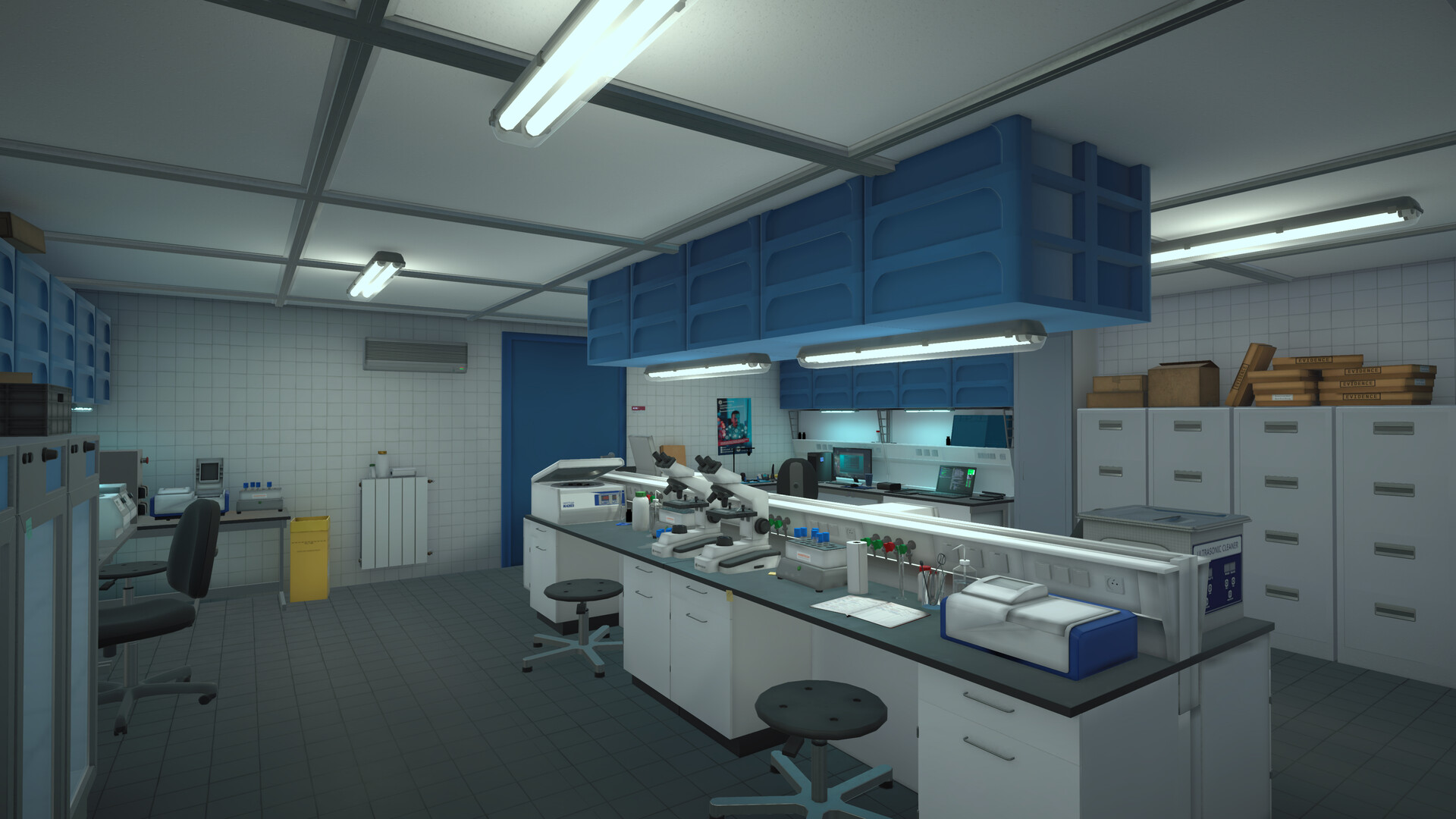
The lab spaces carry that same functional tone, presenting analysis as workspace rather than spectacle. It is not a game reaching for beauty, and judging it on visual flourish would miss the point; the presentation is in service of believability, and on that narrow measure it largely succeeds. The scenes feel like places where something happened, which is most of what a game like this needs from its art direction.
The limits are those of budget and polish rather than vision. This is plainly a mid-tier production, and the rough edges that show up in the systems show up here too, in stiff interactions and a general lack of finish. The atmosphere is genuine, but it is fragile, and every unskippable tutorial prompt and every progression hiccup punctures the very immersion the mood works to create.
A refreshingly authentic forensic sim with a real identity, dragged down to the middle by clumsy onboarding, self-defeating friction, and launch-day bugs.
Pros & cons
The ledgerIn its favour
- Genuinely authentic, procedure-first forensic work grounded in expert consultation
- A deliberate, methodical pace that stands apart from every other crime game around it
- Real satisfaction in assembling a case from small, patiently gathered evidence
- Restrained, believable crime scenes with a convincing clinical atmosphere
- Fair mid-tier price that sets honest expectations for a niche simulator
Against it
- A one-item carry limit turns evidence collection into tedious back-and-forth trips
- Mandatory, unskippable tutorials that several players found confusing rather than helpful
- Steep learning curve and awkward controls make for a rough opening few hours
- Progression bugs that can stall cases through no fault of the player
- Slow pacing and rough onboarding will alienate anyone not already sold on the premise
Screens
Official media© Aerosoft GmbH. Official media via Steam.
The player verdict
Real reviews · Steam- Not recommended
“I going to keep this simple. UI bad UX bad Game lacks any depth Mission don't lend themselves to or into one another You do no "investigative" conclusions yourself At the time of writing, the final nail for me was no more mission…”
381 found helpfulvia Steam - Not recommended
“I saw so much potential in this game, and was so excited for it to release. from what i've played so far, it felt like a demo; 4 tutorials before I played 3 bare bones levels that had less content than those tutorials. I wasn't aware there…”
144 found helpfulvia Steam - Not recommended
“Forensics: Crime Scene Detective hat eine spannende Grundidee: Tatorte untersuchen, Beweise sichern und anschließend im Labor Fingerabdrücke, DNA-Proben, Projektile und elektronische Geräte analysieren. Gerade für Hobby-Forensiker steckt…”
121 found helpfulvia Steam - Recommended
“As a mortician and forensic technician, this hits different. (even if reviews are mostly negative) This game is genuinely fun and brings back a lot of memories minus the actual physical and mental stress, thankfully. A must-try for…”
103 found helpfulvia Steam
Verdict
The callForensics: Crime Scene Detective is a good idea that shipped a patch cycle too early. Its ambition, to make the slow, careful discipline of real forensic work into a game, is genuinely worth pursuing, and when the loop of scene work and lab analysis clicks, it offers something you cannot get from the glossier crime games it shares a storefront with. The atmosphere is convincing and the intent is honest.
But good intent does not survive a one-item carry limit, unskippable tutorials that confuse more than they teach, controls that fight you, and progression bugs that stall cases outright. Each of these is fixable, and none is a fatal flaw of design, but together they define the launch experience, and they land hardest in exactly the early hours where a niche sim needs to win you over. The Mixed player reception is not a mystery; it is the sound of two audiences having very different first days.
If you are drawn to authentic, deliberate simulation and you have patience for rough edges, there is a rewarding game in here worth watching, especially once the reported issues are patched. If you want a crime experience that respects your time out of the box, this is not yet that game. Buy it for what it is trying to be, wait a few updates for it to actually get there, and keep your expectations calibrated to a promising work in progress.
Sources
Original review by Aymen Sakouhi from the licensed facts above. Score: 6.0/10.