Chessferatu Wants You to Play Your Openings, Not Memorize Them
A chess opening trainer that makes you play the lines, then keeps fighting once your opponent leaves the book. Our Chessferatu verdict: 6.4/10.
Aymen Sakouhi·Writer · Games Hobbyist//5 min read
© Half-Cocked Studios. Official media via Steam.
The pitch
OverviewOpening study is where most chess improvement is promised and most of it quietly dies. You buy the book, you drill the main line ten moves deep, and then the first opponent you meet plays move three wrong and every diagram in your head evaporates. The knowledge was never really yours. It was rented, and it left the moment the position stopped matching the page.
Chessferatu, the debut from Half-Cocked Studios released on 18 July 2026, is built around that exact failure. Its pitch is refreshingly narrow: stop memorizing opening lines and start playing them. You pick an opening, you sit in the position, and you learn what the thing is actually trying to do on the board rather than which square the notation says to touch next. It is a single-player training tool with a knowing horror pun for a name, not a grand strategy epic, and it is best judged on the one question that matters for a study aid: does it make the lessons stick.
The pitch lands in a crowded room. Spaced-repetition trainers, engine coaches, and free web drills already fight over the same improving-player audience, and several of them cost nothing. Chessferatu's wager is that repetition through actual play, plus a refusal to end the exercise the instant theory does, teaches better than flashcards. That is a real, defensible idea. Whether it is worth its asking price over the free competition is the harder question the game has to answer.
What follows is a look at what the tool sets out to do and where its design leaves room for doubt. It is brand new, it carries no track record yet, and this is an assessment of its approach rather than a verdict on hundreds of logged hours.
How it plays
PlayThe core idea is simple enough to explain in a sentence: you learn an opening by repeatedly playing the positions it produces. Instead of reading a line and nodding along, you choose an opening, step into the resulting position, and make the moves yourself, so the shapes and plans build up as muscle memory rather than trivia. It is the difference between reading a recipe and cooking the dish a dozen times, and for openings that distinction is the whole point.
It is also the direction the whole category has been drifting for years. Opening study used to mean a book and a board, then a database and a mouse, and more recently a wave of spaced-repetition trainers and engine coaches that turn lines into flashcards to be reviewed on a schedule. Those tools are genuinely effective at retention, but they share a blind spot: they train you to recall a move, not to understand why the position wants it. Chessferatu's insistence that you sit in the position and play it is a direct answer to that gap, and it is the more ambitious teaching philosophy of the two.
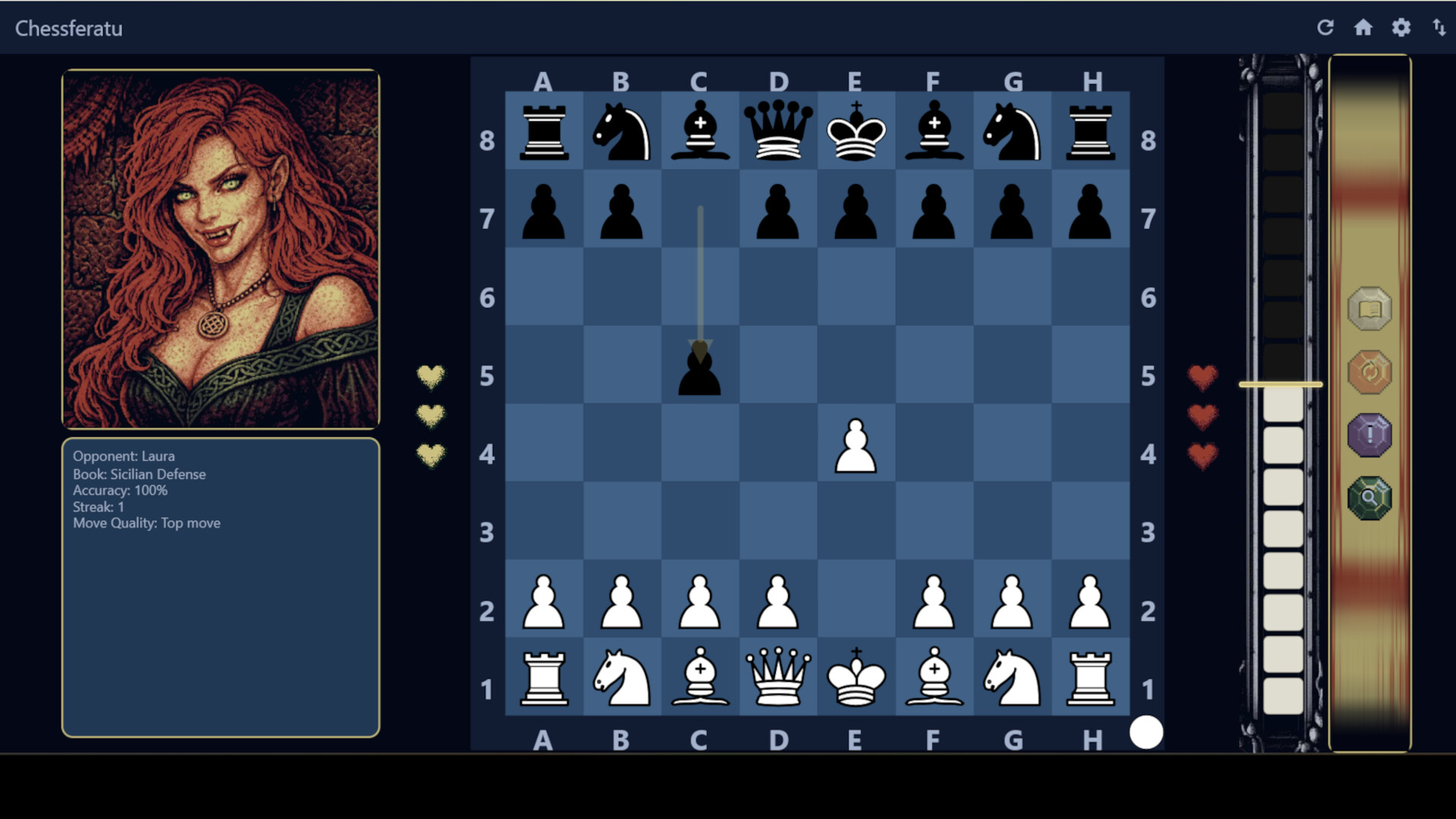
The idea is split across three modes. Openings Battle sends you through opening lines against themed opponents, framing study as a series of fights to win rather than a list to recite. Openings Study is the focused-practice lane, letting you drill specific opening families and their variations at your own pace. Battle Free for All loosens the structure and lets you play with live move evaluation, testing your own decisions as you go. The three cover a sensible spread, from guided repetition to open-ended experimentation, and the split suggests the developer understands that drilling and free play teach different things.
The most interesting design choice is what happens when the book runs out. Real opponents leave theory constantly, and most opening trainers simply stop being useful the moment they do, leaving you stranded with a memorized sequence and no idea why any of it mattered. Chessferatu keeps going. The battle continues off-book, with live move evaluation and engine refutation stepping in to punish the plausible-looking mistakes that theory never warned you about. If it works as described, this is the feature that separates it from a glorified flashcard deck, because it targets the exact moment where rote memorization fails a real player.
The accessibility framing is sensible for the subject. It is playable without timed input, so you can sit and think without a clock breathing down your neck, and difficulty is adjustable, which matters enormously for a tool meant to serve both a rising beginner and a rated club player. Custom volume controls and single-player focus round out a package that is clearly built as a quiet, personal practice room rather than a competitive arena.
The open questions are all about depth, and none of them can be answered from the store page alone. How broad is the opening library, and does it reach the sidelines you actually face or only the headline systems? How substantive are the themed opponents, and do they play meaningfully different styles or just wear different costumes? Above all, how good is the evaluation and refutation layer at explaining why a move is wrong rather than only flagging that it is, because a trainer that says no without saying why teaches far less than one that shows the punishment. These are the hinges the whole thing swings on, and at launch they remain unproven.
Art & atmosphere
CraftThere is a real design job hiding inside a tool like this, and it is not spectacle. A trainer lives or dies on legibility: the board has to read instantly, the evaluation has to sit where your eye can find it, and the feedback has to be clear enough that a lesson lands in the half-second before you move on to the next repetition. The most valuable craft Chessferatu can offer is a clean, unambiguous presentation that stays out of the way of the study, and that is the standard by which its interface deserves to be judged.
The personality is in the name. Chessferatu leans on the old Nosferatu pun and a cast of themed opponents, a small, self-aware bit of theatre draped over what is fundamentally a drilling app. That instinct is smart. Opening study is dry by reputation, and a light gothic frame is exactly the kind of low-cost charm that can make a repetitive exercise feel like a game worth returning to rather than a chore to endure. The risk is that the costume stays skin-deep and the opponents behind the theming all play the same, which would turn a promising hook into set dressing.
As an aesthetic object, then, this is a piece of software asking to be measured on clarity first and character second. If the board is crisp, the evaluation readable, and the horror-movie framing genuinely warms up the grind, the presentation will have done its real job. None of that requires a big budget, and for a trainer it matters far more than any amount of visual flourish would.
A smart, well-aimed take on opening study whose real value stays unproven at launch and sits against strong free competition.
Pros & cons
The ledgerIn its favour
- A genuinely useful core idea: learn openings by playing them, not memorizing them
- Keeps teaching off-book, where most opening trainers simply give up
- Three modes cover guided drilling, focused study, and free experimentation
- No time pressure and adjustable difficulty suit beginners and club players alike
- A light gothic pun gives dry study material some welcome personality
Against it
- Faces strong free competition from established web and app trainers
- Fifteen dollars is a real ask for a single-purpose study tool
- Opening-library breadth and the depth of its explanations are unproven at launch
- The themed opponents may be flavor rather than genuinely distinct styles
- Single-player and single-subject: this is a drilling room, not a full chess suite
Screens
Official media© Half-Cocked Studios. Official media via Steam.
Verdict
The callChessferatu is built on the right insight. Openings are learned by playing them until the plans feel obvious, and a trainer that keeps coaching once the opponent goes off-book is aiming at the precise spot where ordinary memorization collapses. As a statement of intent, that is more thoughtful than most study tools bother to be.
The caution is entirely practical. This is a new, single-purpose tool from a first-time studio, priced at around fifteen dollars in a field where capable free alternatives exist, and the details that would prove its worth, the breadth of its library and the quality of its explanations, cannot be verified until players have logged serious time in it. The concept is sound; the execution is still a promise.
Recommend it, then, to the improving player who knows they hate rote memorization and wants their opening work to feel like playing rather than revising, provided they are comfortable paying for the convenience and the framing over the free options. Treat it as a focused practice room with a fun costume, not a complete chess education, and it may earn its keep. Just go in knowing you are betting on an idea that is still proving itself.
Sources
Original review by Aymen Sakouhi from the licensed facts above. Score: 6.4/10.